Implemented 15 September 2026
Agentic commerce
What the service is
We open your business to purchase by autonomous agents. We describe your offers in machine-readable form, open a path to an order and a payment, and connect the incoming order to your system.
An agent can recommend any company. It can order from and pay only the one that left it a way to do so. Where the path is missing, the work goes back to a person — and often does not come back at all.
Trade, or clever automation
One distinction matters more than any other. When two or more parties already have a signed contract, fixed prices and established delivery channels, using software to execute the orders is not agentic commerce. It is pure automation. There the algorithm is transport, carrying a request from A to B along a route drawn in advance. That closed scenario lacks the one thing that matters: a market. No competition, no judgement of quality, no comparison of alternatives.
Real agentic commerce carries the freedom to choose. It happens when an algorithm surveys an open market on its own, compares the offers, judges them by rules imposed only by its own user, and closes a deal with a supplier it has never dealt with before. Competition there is complete, and the demands on the supplier are enormous. The machine has to pick you out of all the others, under no prior obligation whatsoever to do so. And you have to be ready to receive it.
Our system is open. The address is public, registration passes through no approval of ours, and no agent needs a prior arrangement with us.
Implemented on our own site
On 15 September 2026 an unknown software agent registered itself on our site. The first transaction took six minutes and thirty-two seconds, because the service required individual pricing by a person. The payment itself was still made by a person.
A few hours later came the real breakthrough. A second agent read the catalogue, compared the offers, accepted the terms and requested payment in 0.6 seconds. The payment was made by a specialised digital wallet with a virtual Visa card, after it asked its own holder for approval. Nobody filled in a single field on a form or a checkout page.
One hundred and twenty-two thousandths of a second after settlement was confirmed, the payment had been reconciled, the client recorded, the work task opened, the next number drawn from the books, the invoice composed and two emails sent. The third, notifying us of the order, had gone three minutes earlier.
Whatever we offer goes through our own company and our own books first.
What it leaves behind
A transaction is not a story we tell. It leaves a trace in two separate systems, and either of them can be opened by somebody who does not take our word for it.
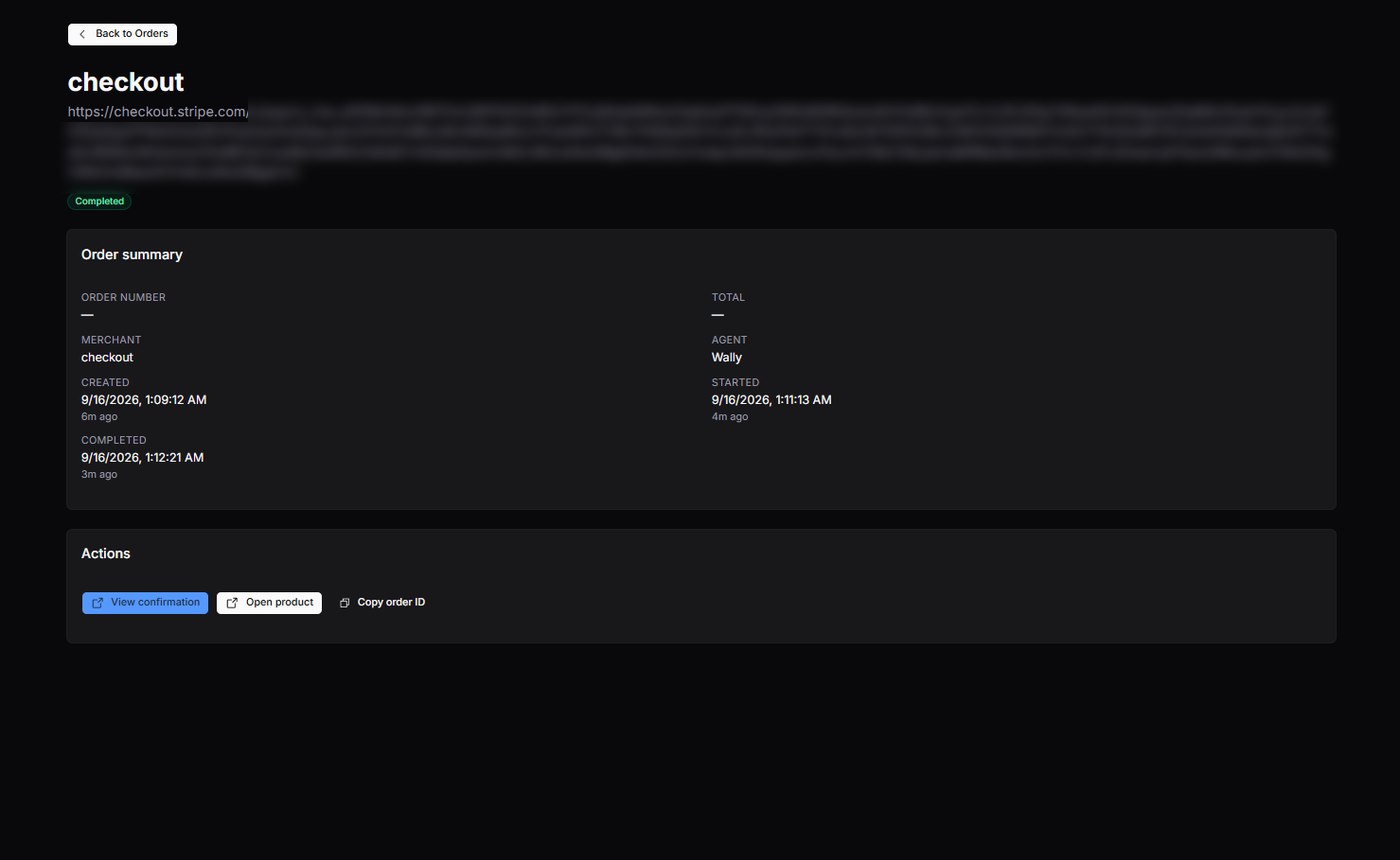
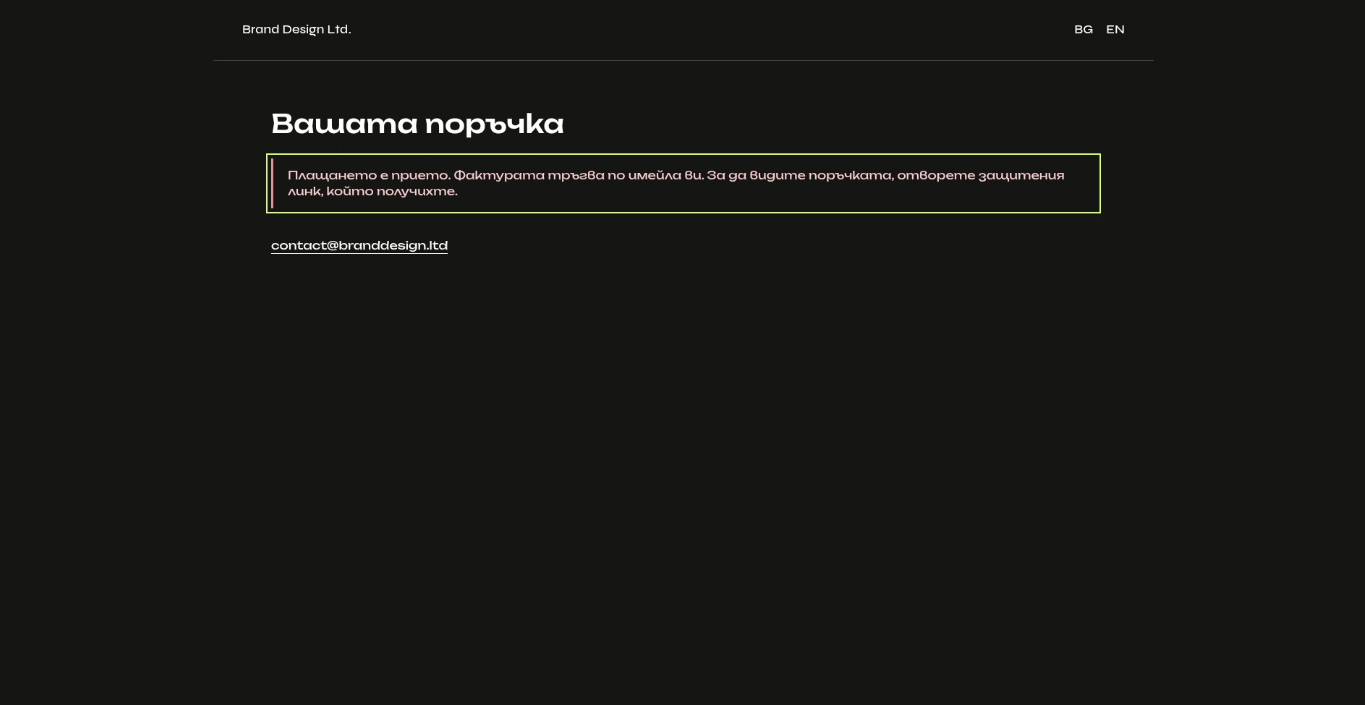
The anatomy of autonomous trust
What does it actually mean for an algorithm to pay by itself? The key difference is not the technical automation but the nature of the mandate. The agent is not given free access to the buyer’s credit card. It is given a one-time right, a kind of digital token, for a stated amount or a specific product, in a specific currency and with a clear expiry. If a single detail fails to match the order, the system refuses the transaction before it even asks for the money. That architecture, tested against the live payment infrastructure of Stripe, limits the damage from an error to the size of the token itself.
The second large difference lies in how the contract is struck. A person reads the page before buying and fills the gaps with intuition. A machine does not read between the lines and does not interpret the design. So every offer is archived byte for byte at the moment it is accepted, and receives its own unique digital fingerprint. The deal is sealed cryptographically.
Years later, what stands is what was recorded at the instant of purchase, not what the site says today.
What the work covers
Opening a channel like this is not a software update or an add-on. It demands complete transactional readiness from the business.
- We describe your services, prices, terms and lead times in machine-readable form, so they are read without guessing.
- We open free registration, with no wait for human approval, and a direct path to payment.
- We bind every offer to the terms as they stand at the moment of the deal, so a later change cannot pass for the agreement.
- We connect the order to your system — client, task, invoice and notification, with nothing carried over by hand.
Four questions before the system
Before you even think about a finished system, you need firm answers to four commercial questions.
- Who is the client, and what rights does their agent hold?
- What exactly does the offer include, with no hidden conditions and no small print?
- Who pays, and by what route does the money travel?
- What happens in the second after the order, so that the accounting and the work both come out clean?
Not one of these is a question for artificial intelligence. They are an examination of the commercial discipline of the company itself.
The global protocols
The technology giants are building global frameworks for the same thing. Google announced the Universal Commerce Protocol together with Shopify, Etsy, Wayfair, Target and Walmart, while OpenAI and Stripe drive the competing Agentic Commerce Protocol. Many companies choose to wait for those standards to settle. That is a convenient illusion and a way to postpone the work.
The expensive, slow part of the process is not the software protocol. An experienced team builds a working system in weeks. The genuinely hard part is organising the offer of the business so that it becomes unambiguous and machine-readable. Once that foundation is in place, the technological wrapper can be replaced at any time.
Our implementation does not wait for the global solutions. It runs on a protocol of our own and is one of the earliest publicly documented agentic-commerce implementations in Bulgaria. We do not claim it is a standard and do not intend it to be. Two transactions are not a market — they prove the chain works end to end, and nothing more.
When it makes sense
- When your services or products are ordered repeatedly and on clear terms.
- When your brand signal is already machine-readable and the next step is action rather than visibility.
- When you work with third-party platforms and agents that need to engage you, not merely mention you.
An open entrance does not create demand. It only removes the reasons a ready transaction fails to happen.
Recommendation as an illusion of success
Today every effort seems aimed at discoverability. Companies fight to have the large language models notice them, mention them and recommend them. But the recommendation of an algorithm is only an intermediate step. It is the beginning of the road, not its end.
When artificial intelligence picks your business, it acts at once. It will not telephone to ask which account to send the money to, nor wait until Monday morning for you to process its request. If in those decisive milliseconds your system is not ready to serve and close the deal, the algorithm removes you from the equation.
And when its task is not to answer “recommend me the best branding company in Bulgaria” but to find that company and order a new logo, it will not even recommend you. Companies without the infrastructure and the firm readiness to sell to agents autonomously will be passed over in silence.
Buyers of this kind are only now appearing. They bring no revenue today and we do not claim otherwise. The point is readiness: when they become ordinary, catching up costs more than preparing now.
The whole process, including the defects found along the way, is published under a free licence with a permanent identifier and an independent date: 10.5281/zenodo.22767915. The machine-readable description, through which any agent reads the catalogue and the rules, is here.